



Bulk Food Grade Vitamin E / Tocopherol
Food-Grade Sodium Carboxymethyl Cellulose (CMC) Application Solutions

Effectively Addresses Protein Sedimentation and Layering in Beverages, Water Separation in Sauces, Ice Crystals in Ice Cream, and Staling in Baked Goods
Cost-Effective, Smooth, Stable, and Reproducible Thickening and Water-Retention Solutions for Food Formulations
Obtain Samples and COA
 Adjust Viscosity
 Control Moisture
 Stabilize Systems
 Improve Texture
 Enhance Performance
 Cost-Effective


Food Grade · E466 (INS 466) · Thickening · Stabilization · Water Retention · Texture Improvement


CMC Food Formulation Challenges

Food-grade sodium carboxymethyl cellulose is one of the most common thickeners in the food industry. It is widely used in the R&D and mass production of beverages, frozen foods, flour products and condiments. It plays an important role in food structure, storage stability, processing performance and final consumer experience. However, in actual formula R&D and production, the following problems are usually encountered.

01

Poor or Unstable Thickening Effect

Common Symptoms
Sauces or beverages fluctuate between being too thin and too thick.
Primary Causes
Mismatched product grade or viscosity; incorrect dosage; insufficient hydration.
02

Separation or Sedimentation During Storage

Common Symptoms
Oil-water separation; settling of proteins or fruit pulp.
Primary Causes
Unstable suspension/emulsion system; improper grade or compound formula.
03

Unsatisfactory Mouthfeel (Too Sticky or Too Thin)

Common Symptoms
Lack of smoothness; stringiness; or insufficient body/thickness.
Primary Causes
Excessive dosage; inappropriate viscosity grade.
04

Powder Clumping and Poor Dissolution

Common Symptoms
Formation of lumps upon addition; uneven consistency of the resulting solution.
Primary Causes
Adding the powder too quickly; insufficient agitation.
05

Viscosity Loss or Sedimentation in Acidic Systems

Common Symptoms
Separation or sedimentation in acidic dairy beverages.
Primary Causes
Standard CMC lacks acid resistance; low Degree of Substitution (DS).
06

Loss of Functionality in High-Salt or High-Calcium Systems

Common Symptoms
Viscosity loss or syneresis (water release) in sauces or meat products.
Primary Causes
Viscosity reduction caused by monovalent salts; precipitation induced by polyvalent ions.
! The issues mentioned above can impose significant unnecessary costs on a business, negatively impacting production efficiency, causing fluctuations in product quality, and driving up overall costs—all of which lead to a decline in customer trust and satisfaction.
Get one-on-one selection support

What Is Sodium Carboxymethyl Cellulose?

Sodium carboxymethyl cellulose is an anionic cellulose ether produced from purified natural cellulose through alkalization followed by etherification with chloroacetic acid or its sodium salt. Food-grade CMC is a white or off-white powder, granule, or fibrous material. It is odorless and tasteless, hygroscopic, and soluble in cold water, where it forms a clear, viscous solution. It is insoluble in fats, ethanol, and other organic solvents. Food-grade CMC is designated as E466 (INS 466) and has CAS No. 9004-32-4. It is also commonly known as cellulose gum.

Sodium carboxymethyl cellulose has a wide range of applications in the food industry, personal care and detergents, industrial and consumer products, pharmaceuticals, and other specialized fields. In food products, its primary functions include thickening, stabilization, water retention, emulsification assistance, and inhibition of ice crystal growth. It is not digested or absorbed by the human body. According to assessments by the World Health Organization (WHO), the Food and Agriculture Organization of the United Nations (FAO), and the European Food Safety Authority (EFSA), it is considered safe when used within applicable limits.

When selecting CMC for food applications, key factors include viscosity, degree of substitution (DS), pH and solution properties, and product purity. Viscosity values measured in 1% or 2% aqueous solutions generally range from tens to several thousand mPa·s, depending on the grade, and should be selected according to the actual application. A higher degree of substitution generally improves solubility, clarity, and resistance to acids and salts. A 1% aqueous solution is generally neutral to slightly alkaline. The solution may exhibit pseudoplastic, shear-thinning behavior, and its viscosity decreases reversibly as temperature rises. Food-grade CMC typically has a purity of at least 99.5%. Higher purity means fewer impurities and generally contributes to more stable product performance and better batch-to-batch reproducibility.

This page outlines the performance of CMC in food applications to help food manufacturers develop higher-quality products.

Polifar Food-Grade CMC | Product Advantages


From thickening and stabilization to water retention and film formation, and from compatibility to batch-to-batch consistency—meeting the full spectrum of requirements for large-scale food production.


Efficient Thickening

Cost-Effective and Easy to Process. Even at relatively low addition levels, CMC can significantly increase system viscosity, helping food manufacturers achieve the desired texture and a better mouthfeel. Its pseudoplastic behavior in aqueous solutions facilitates pumping, spreading, processing, and filling.


Protein System Stabilization

In neutral beverages containing protein, the anionic nature of CMC allows it to adsorb near particles or oil-water interfaces. It increases the viscosity of the continuous aqueous phase, effectively delaying aggregation and sedimentation and improving product uniformity.


Water Retention and Delayed Staling

Food-grade CMC offers excellent hydration and water-retention properties in food systems. It helps inhibit ice crystal formation, reduce water separation and iciness in quick-frozen and frozen foods, and slow starch retrogradation in flour-based products. It can help prevent bread from becoming hard too quickly and improve product quality during storage.


Excellent Film-Forming Properties

When a CMC solution dries, it forms a transparent, flexible film. This property gives CMC specific applications in edible coatings, anti-sticking treatments for confectionery, and food preservation. It can also help build structure in gluten-free formulations.


Good Compatibility

CMC is suitable for a wide range of food formulations and is compatible with gelatin, xanthan gum, carrageenan, locust bean gum, guar gum, agar, sodium alginate, pectin, gum arabic, and various starch derivatives. It can help balance viscosity, suspension, and mouthfeel.


Batch-to-Batch Consistency

When purchasing CMC, food manufacturers place great importance on batch consistency, viscosity uniformity, quality testing documents, and supply capacity. As a CMC supplier, Polifar can control viscosity, DS, pH, and moisture according to specifications, helping reduce formulation adjustments caused by batch variations. Polifar also assists customers with one-stop sourcing.

CMC Viscosity Selection Guide

Sodium Carboxymethyl Cellulose (CMC) COA

Polifar offers food-grade CMC in five standard viscosity grades, catering to a full range of applications—from beverages to ice cream; custom viscosity options are also available.

Item Low viscosity
500–1000
Medium-low
1000–1500
Standard medium
2500–3000
Medium-high
5000–5500
High viscosity
6000–7000
Physical Exterior White Powder White or Yellowish Powder White or Yellowish Powder White or Yellowish Powder White or Yellowish Powder
Viscosity (1% mPa·s) 500-1000 1000-1500 2500-3000 5000-5500 6000-7000
Degree of Substitution 0.70-0.95 0.8-0.9 0.8 Min 0.7-0.85 0.6-0.9
PH (25°C) 6.5-8.5 6.5-8.5 6.5-8.5 6.5-8.5 6.0-8.5
Moisture (%) 8.0 Max 8.0 Max 8.0 Max 8.0 Max 10.0 Max
Purity (%) 99.5 Min 99.5 Min 99.5 Min 99.5 Min 99.5 Min
Heavy Metal (Pb), ppm 10 Max 10 Max 10 Max 10 Max 10 Max
Iron, ppm 2 Max 2 Max 2 Max 2 Max 2 Max
Arsenic, ppm 3 Max 3 Max 3 Max 3 Max 3 Max
Lead, ppm 2 Max 2 Max 2 Max 2 Max 2 Max
Mercury, ppm 1 Max 1 Max 1 Max 1 Max 1 Max
Cadmium, ppm 1 Max 1 Max 1 Max 1 Max 1 Max
Total Plate Count 500/g Max 500/g Max 500/g Max 500/g Max 500/g Max
Yeast & Moulds 100/g Max 100/g Max 100/g Max 100/g Max 100/g Max
E. Coli Nil/g Nil/g Nil/g Nil/g Nil/g
Coliform Bacteria Nil/g Nil/g Nil/g Nil/g Nil/g
Salmonella Nil/25g Nil/25g Nil/25g Nil/25g Nil/25g

How to Choose the Most Suitable CMC Viscosity?

Low viscosity
500–1000
mPa·s
Medium-low viscosity
1000–1500
mPa·s
Standard medium viscosity
2500–3000
mPa·s
Medium-high viscosity
5000–5500
mPa·s
High viscosity
6000–7000
mPa·s

Low Viscosity

Rapidly Soluble · Easily Dispersible

Dissolves quickly in water; ideal for product systems that require high fluidity and where excessive thickening is undesirable.

Beverages thin sauces instant products

Medium Viscosity

Balanced Choice · Most Widely Used

Offers a balance between thickening performance, stability, and fluidity; the preferred, versatile choice for dairy products, baked goods, and sauces.

Dairy products yogurt baked goods sauces

High Viscosity

Strong Thickening · High Water Retention

Suitable for systems requiring significant thickening, high water retention, and excellent suspension capabilities; also applicable in areas such as industrial drilling fluids.
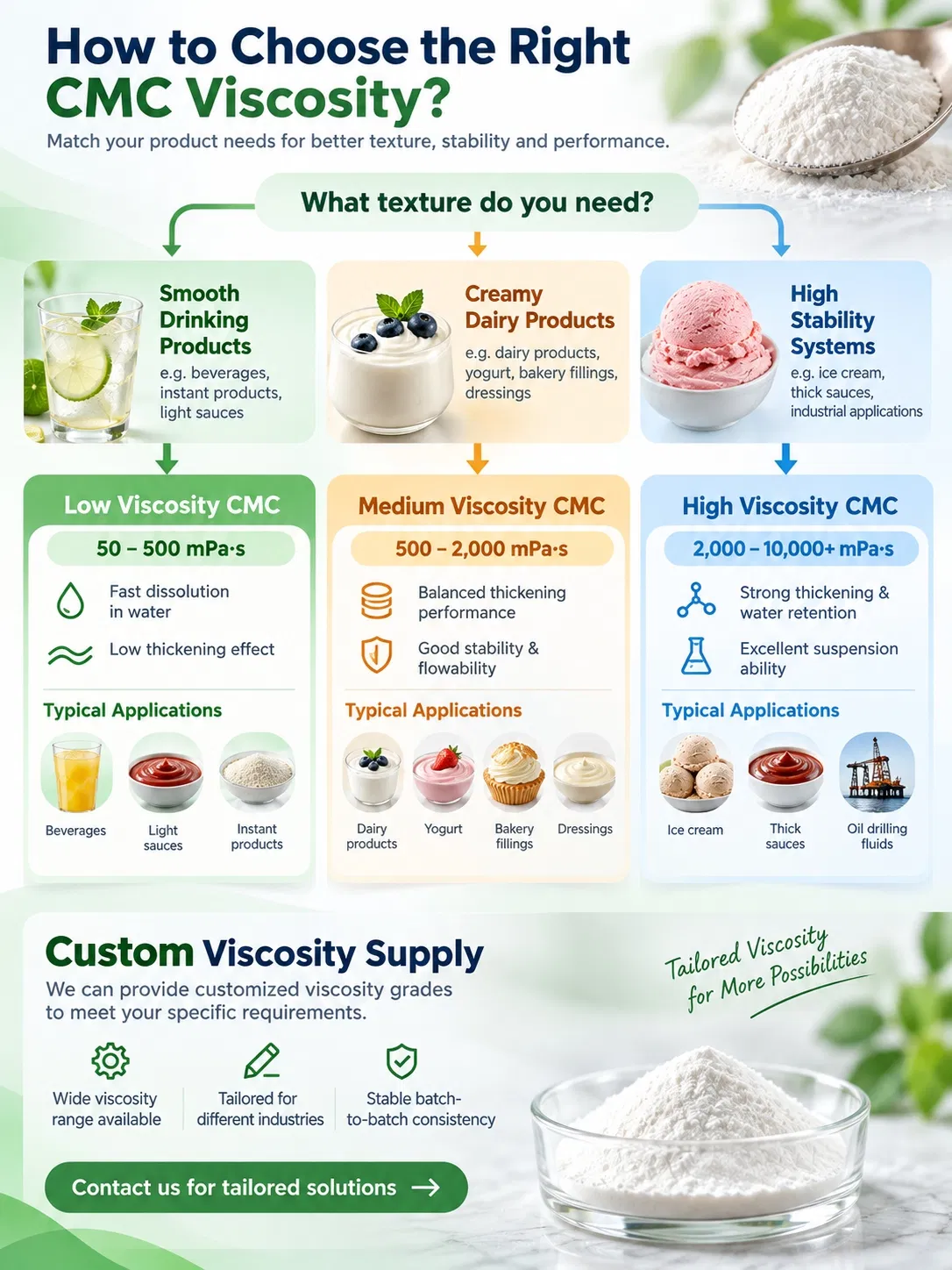
Ice cream thick sauces frozen foods
Food-Grade-Sodium-Carboxymethyl-Cellulose-CMC-E466-Thickener-for-Food-Beverage
Food-Grade CMC Applications

Food-Grade CMC Applications

Covers six core sectors: beverages, dairy products, confectionery, bakery, sauces, and frozen foods.

Beverages and Juices

Beverages and Juices

Sedimentation of plant proteins Layer separation during storage Settling of fruit pulp Fat rising to the surface Thin mouthfeel

In plant-based protein beverages, food-grade CMC can adsorb onto casein and help stabilize proteins, reducing floating or sedimentation and improving the overall stability of the beverage. In beverages containing fruit pulp or plant particles, it can reduce the settling rate and improve smoothness.
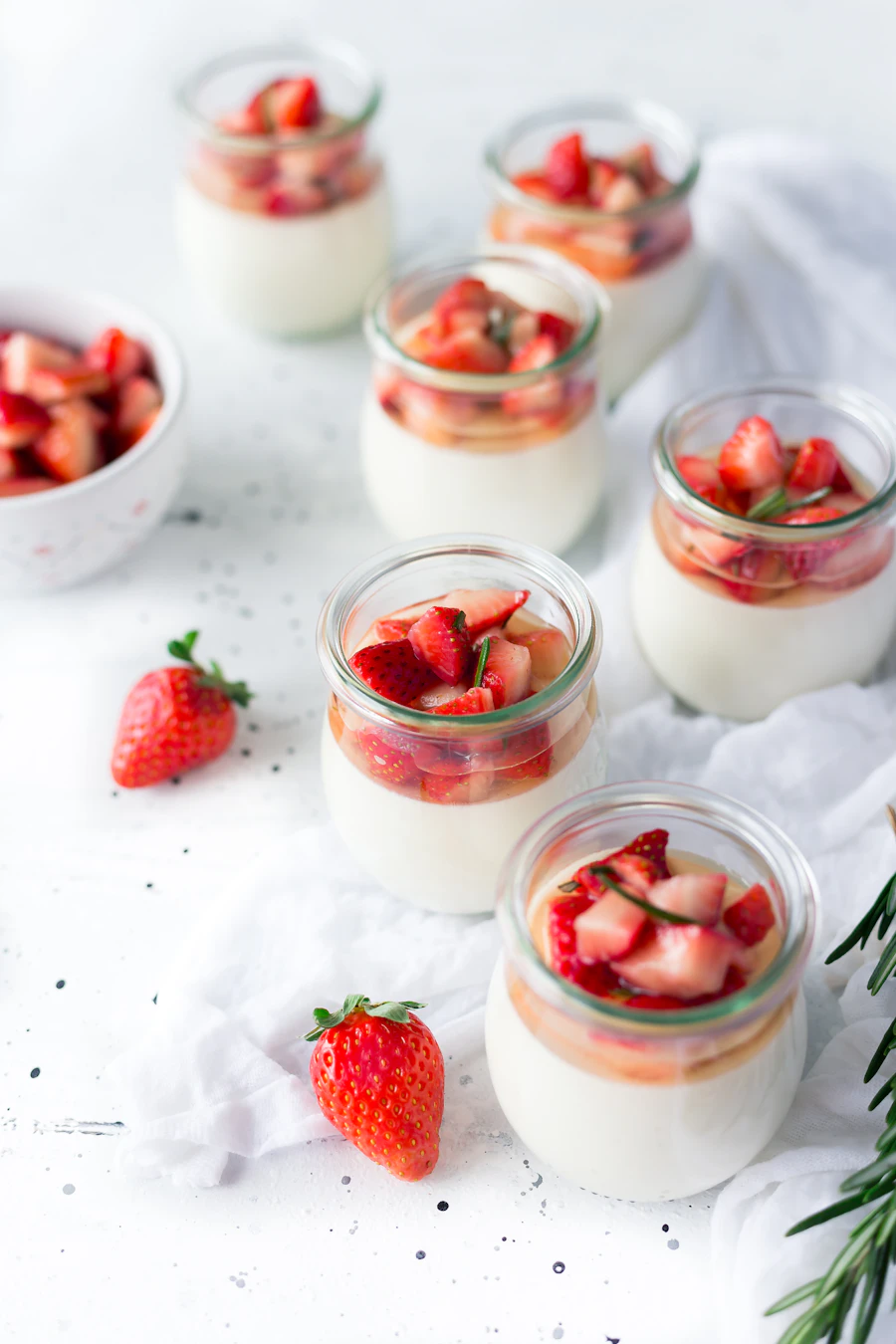
Plant-based protein beverages (soy milk) Fruit juice drinks Beverages containing fruit pulp Flavored beverages Selected compound systems for powdered drinks
Dairy Products

Dairy Products

Uneven texture Rough or insufficiently creamy mouthfeel Whey separation Inadequate storage stability

Adding an appropriate amount of food-grade CMC to dairy products can stabilize the system, improve consistency, reduce whey separation and sedimentation, and create a smoother mouthfeel, helping to extend shelf life.

Stirred yogurt Probiotic drinks Fruit-flavored milk Neutral-pH milk beverages Plant-based milk alternatives
Confectionery and Gel-Based Foods

Confectionery and Gel-Based Foods

Sugar crystallization Gummies becoming hard or sticky Gel candies losing their shape Rough texture Poor storage stability

CMC has good water-holding and film-forming properties. It can improve the flexibility of confectionery and help retain moisture. In gel-based foods, blending CMC with gelling agents such as gelatin or agar can improve product uniformity, stability, and texture.

Gummies Fruit-flavored candies Filled candies Gel candies Jelly & pudding Fruit-pulp gels Foods requiring thickening or water retention
Bakery and Flour-Based Products

Bakery and Flour-Based Products

Bread and pastries become stale, hard, and crumbly Noodles lack elasticity Inadequate dough structure Poor finished product appearance

In selected bakery formulations, adding an appropriate amount of food-grade CMC can improve water retention and softness in dough, help optimize processing properties and the structure of finished products, and delay staling and hardening.

Gluten-free bread Cakes Biscuits Bread premixes Bakery fillings Other baked goods
Sauces and Condiments

Sauces and Condiments

Sauces are too thin and do not adhere well to food Oil-water separation during storage Spice particles settling Noticeable batch-to-batch variation in flow behavior and texture

Food-grade high-viscosity CMC can be used in high-salt and strongly acidic systems, but it is generally preferable to combine it with xanthan gum. This can help inhibit particle settling, maintain thickening performance, stabilize the overall sauce system, and improve flow behavior and texture.

Salad dressings Ketchup Barbecue sauces Compound seasoning sauces Dipping sauces Soy sauce Chili sauce Peanut butter
Frozen and Convenience Foods

Frozen and Convenience Foods

Frozen products release water and develop ice crystals Hard texture Convenience foods lack elasticity Products break easily

When used appropriately in a formulation, food-grade cellulose gum can inhibit ice crystal formation in food systems, improve texture, and help reduce breakage in convenience foods.

Ice cream Ice pops Frozen dairy products Frozen desserts Frozen ready-to-eat foods Frozen flavored foods

What Can Industrial-Grade CMC Be Used For?

Like industrial-grade xanthan gum, industrial-grade CMC can be used in oil-drilling fluids. It is also used in personal care and daily chemical products, detergents and cleaning products, construction materials, paper, and textiles. The image below illustrates the wide range of applications for industrial-grade cellulose gum.

CMC applications

Differences Between CMC and other Thickeners

Thickening agents Sources and Characteristics Acid / Salt resistance Suspension capability Typical Applications Relative cost
CMC (Carboxymethyl cellulose) Cellulose derivatives: cold-water soluble, pseudoplastic, excellent water retention Moderate / Moderate (sensitive to polyvalent ions) Weak to moderate Protein-based beverages, frozen desserts, noodle/pasta products low
Xanthan gum Microbial fermentation polysaccharides: possess a yield value Excellent / Excellent Strong Sauces, beverages with suspended particles, salad dressings in
Guar gum Guar gum: non-ionic, high thickening efficiency Moderate / Good Weak to moderate Ice cream, noodle/pasta products, meat products low to medium
Sodium alginate Brown algae (alginates): form thermally irreversible gels in the presence of calcium ions Poor (precipitates at low pH) / Sensitive to calcium Moderate Restructured food products, artificial fish roe, noodle/pasta products in
Gelatin Animal collagen: forms thermally reversible gels, provides a soft elastic texture Moderate / Good Not applicable Gummies, jellies, mousses in
Pectin (high-methoxyl) Citrus/apple-derived (pectins): form gels under acidic, high-sugar conditions Excellent / Moderate Moderate Jams, stabilization of acidic dairy beverages medium to high
Carrageenan Red algae (carrageenans): interact significantly with potassium ions and milk proteins Moderate / Good Moderate Dairy products, meat products, gelled products in
Gellan gum Microbial fermentation products: provide high suspension capacity at extremely low usage levels Good / Good Very strong Plant-based protein beverages, beverages with suspended particles high
Modified starch Modified starches: low cost Varies by grade Weak Sauces, fillings, frozen foods low
Colloidal microcrystalline cellulose Co-processed microcrystalline cellulose (MCC) and CMC Good / Moderate Strong (network structure) Neutral-pH dairy beverages, chocolate milk in

Quick Selection Guide:

  • • For cost-effective viscosity improvement, water retention, and freeze-thaw stability: Choose CMC first.
  • • For long-term particle suspension and resistance to high salt and strong acids: Choose xanthan gum or gellan gum.
  • • For an elastic, chewable gel: Choose gelatin, carrageenan, or sodium alginate rather than CMC.
  • • For protein stabilization in acidic milk beverages: Choose pectin.
  • • For comprehensive stabilization of neutral protein beverages: Consider a blend of microcrystalline cellulose, CMC, and gellan gum/carrageenan.

Different thickeners are not directly interchangeable. Grade selection has a direct impact on texture stability, processing performance, and total cost. Blending ratios should be confirmed through preliminary trials.

Global Food Companies' Choice

2023 FDA
HALAL
COA-CAA
COA-CAM
ISO 2021

File Download

Name Size Downloads Update Thumbnail Copy Link Download
Polifar 500-1000cps CMC COA 2%.pdf 198KB 0 2026-11-26 download Copy Link Download
Polifar 1000-1500cps CMC COA.pdf 198KB 0 2026-11-26 download Copy Link Download
Polifar 2500-3000cps CMC COA.pdf 198KB 0 2026-11-26 download Copy Link Download
Polifar 5000-5500cps CMC COA.pdf 198KB 0 2026-11-26 download Copy Link Download
Polifar 6000-7000cps CMC COA.pdf 199KB 0 2026-11-26 download Copy Link Download

FAQ


  • Q1: Can CMC and xanthan gum replace each other?
    加 Created with Sketch.
    形状 Created with Sketch.
    A1: They are not directly interchangeable. Xanthan gum offers good acid and salt resistance and strong suspension properties, while CMC is more cost-effective and provides good water retention and protein stabilization. Many formulations combine the two to balance viscosity, suspension, and cost.
  • Q2: How should I choose the viscosity grade and degree of substitution?
    加 Created with Sketch.
    形状 Created with Sketch.
    A2: High-viscosity grades are suitable when strong thickening is needed at a low addition level, while low-viscosity grades are easier to process and disperse. For acidic or salt-containing systems, grades with a higher and more uniform degree of substitution are generally preferred. We recommend providing details of the application system, including pH, salt content, and sterilization method, so that technical personnel can recommend a suitable grade. Preliminary trials are recommended.
  • Q3: Can Polifar provide CMC samples?
    加 Created with Sketch.
    形状 Created with Sketch.
    A3: Sample testing and specification consultations may be available in accordance with the applicable product supply policy. The sample quantity, shipping cost, minimum order quantity, and delivery time need to be confirmed based on the product specifications, inventory, and order details.
  • Q4: Can Polifar supply other food thickeners?
    加 Created with Sketch.
    形状 Created with Sketch.
    A4: Yes. Based on customers’ food application requirements, Polifar can provide grade selection and sourcing advice for CMC and other commonly used food thickeners, helping customers purchase multiple ingredients and integrate their supply chains.
  • Q5: How can CMC be dissolved without forming lumps?
    加 Created with Sketch.
    形状 Created with Sketch.
    A5: Do not add all the powder at once. First, dry-blend it with sugar, salt, or starch, then slowly sprinkle the blend into the water while stirring. Maintain sufficient shear and dispersion. Water temperature, feeding speed, and mixing conditions all affect hydration.

Related Products for You

Feel Free to Drop a Line
  • Head Office: Room 612, Building B-1, Greenland Window Business Plaza, No. 2 Jinlan Road, Jiangning District, Nanjing

    Guangzhou Branch Office: Room 802, Deshun Building, No. 70, Huizhi 3rd Road, Panyu District, Guangzhou
  • Feed Additives: sales@polifar.com

    Food Additives: food.sales@polifar.com
  • Feed Additives:86-025-83463431

    Food Additives:86-025-84431783

    Logistic Department: 86-18956009958
    ​​​​​​​