
 English


Views: 0 Author: Site Editor Publish Time: 2026-11-17 Origin: Site


In animal nutrition, livestock and poultry farming, feed additives and premix formulations, precise iron supplementation has always been one of the core elements in improving farming profitability. Iron helps animals maintain hemoglobin synthesis and oxygen transport, strengthens immune function and improves production performance. Ferrous carbonate, an efficient and safe iron source supplement, is one of the most common and popular weakly organic acid salt iron sources in feed additives. Today, many feed mills, premix producers, veterinary drug formulators and food ingredient procurement teams prioritize this raw material for comparative evaluation. As a ferrous carbonate supplier, Polifar provides a comprehensive review of what ferrous carbonate is, together with its applications, advantages and risks.
Ferrous carbonate has the chemical formula FeCO₃ and the CAS number 563-71-3; its natural mineral form is siderite. In its pure form it is a white or pale greenish-gray crystal or powder. It is relatively stable in a dry environment, but in humid, oxygen-rich or brightly lit conditions it oxidizes very easily, turning brown or yellowish brown. Its theoretical iron content is approximately 38%–42%. It has low water solubility and is absorbed relatively well in a mildly acidic environment. Compared with highly water-soluble ferrous sulfate, ferrous carbonate is more stable during feed processing and does not damage vitamins, lipids and other nutrients in premixes, thus preventing nutrient loss.
The core advantages of ferrous carbonate as a feed additive are safety and practicality, easy absorption, low irritation, strong formulation compatibility and outstanding cost-effectiveness. It does not affect feed color or flavor and is well suited to industrial-scale premix production. It also helps prevent anemia, strengthens immunity and production performance, and extends premix shelf life. Each of these advantages is explained below.
Safe and Practical: Ferrous carbonate has very low toxicity and leaves no significant metabolic residue in the animal body, meeting the safe-use standards of most countries.
Stable Bioavailability in an Animal-Friendly Ferrous Form: Divalent (ferrous) iron is the form preferentially absorbed by the animal intestine. It is released slowly under gastric acid conditions and is absorbed significantly more efficiently than trivalent (ferric) iron.
Low Irritation and a Light Burden on the Gut: Because it is poorly soluble in water, it does not dissociate rapidly the way ferrous sulfate does. Even at high inclusion rates it is unlikely to burn the intestinal mucosa, which reduces diarrhea and stress in piglets.
Better Formulation Compatibility: It does not rapidly ionize into large amounts of free iron ions, which reduces catalytic oxidative damage to vitamins A, D, E and the B group, oils, lutein and other antioxidant and nutritional components, thereby extending feed shelf life.
Outstanding cost-effectiveness: Compared with organic chelated iron sources such as ferrous glycinate and ferrous methionine, ferrous carbonate has a lower purchase cost and suits large-scale conventional feed formulations, balancing performance and cost.
No impact on feed flavor or color: High-quality feed-grade ferrous carbonate does not quickly darken or roughen the feed. Its taste is mild, and its effect on feed palatability is negligible.
Suitable for industrial premix production: It has excellent flowability, and modified grades resist caking, which facilitates continuous mixing and pelletizing of trace-element premixes.
Effective anemia prevention: It supplies an essential trace element, promotes red blood cell production and significantly reduces mortality and morbidity in young livestock and poultry.
Enhanced immunity and production performance: As the prosthetic group of many enzymes, iron participates in energy metabolism and immune responses. Adding ferrous carbonate helps improve disease resistance, daily weight gain and feed conversion ratio.
Ferrous carbonate is widely used in practice and plays an irreplaceable role in the chemical industry, food, feed additives, pharmaceuticals and agricultural soil improvement. For buyers in the feed industry, however, the most relevant use is in premixes, compound premixes and trace-element premixes.
Ferrous carbonate is widely used for iron supplementation in livestock and poultry feed, ruminant feed, aquatic animal feed, premixes and compound trace-element premixes, and veterinary premixes. As a feed additive distributor, Polifar explains these applications in detail below.
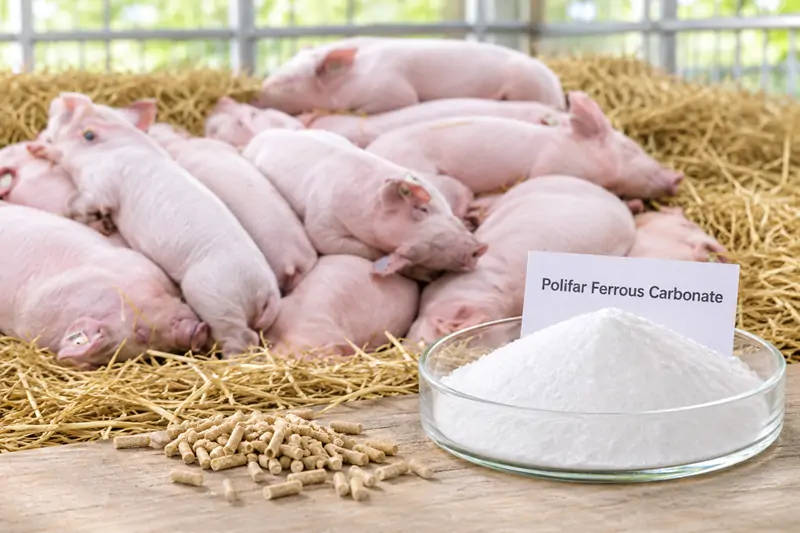
Premixes for sows and breeding stock: Pregnant and lactating sows have high iron requirements. Sufficient iron reserves reduce weak piglets and anemia in newborn piglets and improve the vitality of newborn piglets.
Creep feed and nursery feed for piglets and suckling pigs, and grower-finisher diets: Piglets are highly prone to iron deficiency, and sow milk does not provide enough iron. However, ferrous carbonate is not particularly effective for piglets; slow-release, low-irritation iron supplements should be selected instead, to reduce the risk of diarrhea and anemia.
Adding ferrous carbonate to feed additives or compound trace-element premixes for cattle, sheep and other ruminants improves iron absorption, reduces the formation of harmful gases such as hydrogen sulfide in the rumen, lowers the metabolic burden on ruminants and enhances the body’s hematopoietic function.
Fish and shrimp require iron for hematopoiesis, gill tissue metabolism and antioxidant metabolism. Ferrous carbonate dissolves only slightly in water, so it is far less likely than ferrous sulfate to discolor water or disturb water quality. Adding ferrous carbonate to compound feed for fish, shrimp and crabs provides greater stability: it supplies the iron required for growth and also helps improve the micro-ecological environment of the pond bottom.
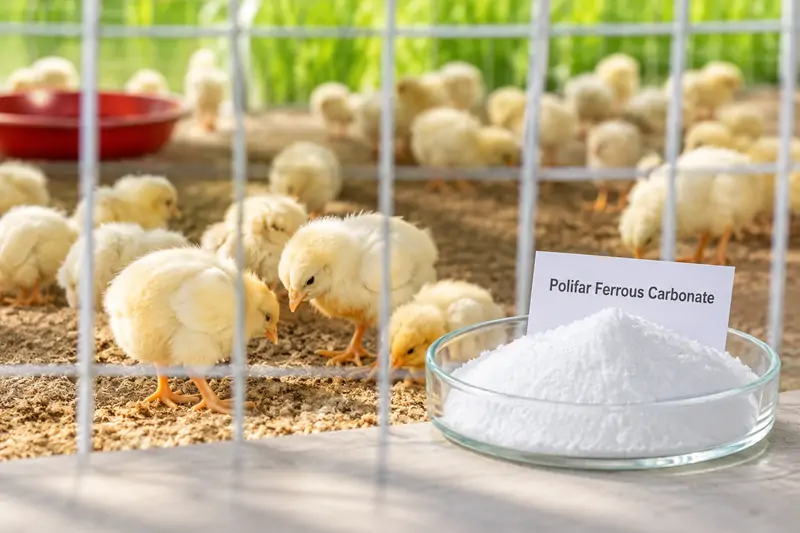
Poultry feed: Diets for chickens, ducks and other conventional poultry require an appropriate amount of ferrous carbonate to meet the hematopoietic demands of rapid growth and to prevent anemia. It improves feather development uniformity in chicks and ducklings, improves broiler growth performance, improves eggshell quality in laying hens and reduces chick mortality.
When combined with vitamins and trace elements such as copper, zinc and manganese, ferrous carbonate can be made into compound iron supplementation premixes for iron-deficiency-related metabolic problems in livestock and poultry.
If a feed places extremely high demands on the oxidative stability of raw materials, or if its formula contains large amounts of highly reactive oils or very high levels of vitamin C, ferrous carbonate is not recommended. Amino acid chelated iron is preferable because it supports digestion, absorption and utilization.
Any chemical raw material should be used in accordance with its chemical safety regulations. Although ferrous carbonate has high nutritional value as a feed additive, buyers and feed manufacturers must not overlook its potential risks. These include possibly lower bioavailability, unsuitability for young animals, excessive intake interfering with the absorption of other minerals, safety concerns over impurities in the raw material, dust hazards during production and processing, and the impact of improper storage on product quality.
The absorption and utilization rate of any nutrient is the first consideration. Ferrous carbonate is poorly soluble in water, so iron is released slowly in the acidic environment of the gastrointestinal tract, and its bioavailability is therefore somewhat lower than that of ferrous sulfate. In addition, ferrous carbonate from different sources and processed in different ways can differ markedly in its effective performance. The amount actually absorbed by the animal cannot be equated with the total iron content of the product.
If young animals are already iron-deficient in utero, their underdeveloped intestines and other organs make it even harder for them to absorb ferrous carbonate after birth, so iron must be supplemented in a timely manner according to the animal’s age. Feed manufacturers therefore need to select the best iron source for each species and growth stage.
Moderation applies to everything: too much is as unsuitable as too little. Iron is an essential trace element for animals, but excessive intake can disrupt the balance and absorption of other trace elements and may increase the risk of stress. Among ruminants, sheep require particular attention to the interaction between iron and copper.
Natural siderite usually contains mineral impurities such as lead, cadmium, arsenic, mercury and nickel in addition to ferrous carbonate. Excessive intake of these elements can poison animals, and people who consume the resulting end products also face food safety risks. Therefore, buyers should look beyond ferrous carbonate content and control impurity levels, which must meet safety standards.
Feed additive manufacturers mostly handle ferrous carbonate in powder form, and dust is present during unloading, feeding, mixing and packaging. During feeding and mixing in particular, workshop workers may be exposed to high concentrations of ferrous carbonate over long periods, often with limited protective equipment, which can affect their respiratory health. Operators should be given proper care, and the workshop should be kept well ventilated.
The divalent iron in ferrous carbonate is sensitive to oxidation, and the storage environment affects product quality. Warehouses should be ventilated and dry, away from direct sunlight and humidity. Sealing, contamination prevention and batch management should also be implemented.
In the feed industry, premix processing and animal nutrition, the most common iron sources besides ferrous carbonate include ferrous sulfate monohydrate, ferrous sulfate heptahydrate, ferrous fumarate, ferric oxide and organic chelated iron such as amino acid chelates (ferrous glycinate, ferrous methionine and similar products).
To help ferrous carbonate buyers and plant formulators select the right source, Polifar has compiled a table comparing the different iron sources across several dimensions. The table below compares ferrous carbonate with common iron sources; iron contents are theoretical values and actual values should be taken from the COA, while bioavailability is expressed relative to ferrous sulfate and varies widely between studies and animal species, so it is for reference only:
| Comparison Dimensions | Ferrous Carbonate | Ferrous Sulfate Monohydrate | Ferrous Sulfate Heptahydrate | Ferrous Fumarate | Ferric Oxide | Organic Chelated Iron |
| Iron content | Approximately 35%-38% | Approximately 33.0% | Approximately 20.1% | Approximately 33% | Approximately 70.0% | 10%-15% |
| Relative biological utilization | 15%-80% | 100% | 100% | Approximate to ferrous sulfate | 0% | 120%-180% |
| Water-soluble | Almost insoluble | Easily soluble | Very soluble | Low to Medium | Insoluble | Slightly soluble/Easily soluble |
| Unit procurement cost | medium | Low | Extremely low | middle | Extremely low | high |
| Stability at room temperature | It absorbs almost no moisture and does not clump. | Slightly absorbs moisture | Extremely hygroscopic and oxidizable | Stablize | Extremely stable | Good stability |
| Premix stability | Okay, but we need to prevent oxidation and discoloration. | better | Poor | good | good | good |
| Disadvantages | Easily oxidized and degraded; antagonized by phytic acid and high calcium-phosphorus content. | It oxidizes very easily, destroying vitamins and oils; it absorbs moisture and clumps; it irritates the intestines of young animals; and it easily causes discoloration of aquatic products due to excessive fat accumulation. | Price higher than ferrous carbonate | Animals can hardly absorb it, so its iron supplement value is extremely low. | High prices and significant cost pressures from large-scale additions | |
| Applicable Scenarios | Piglet nursery feed, sow premix, poultry, fish and shrimp feed, and conventional trace element premix. | Low-cost formula, short-term iron supplementation, and short shelf life of finished product feed | Mid-to-high-end starter feed, formula for young livestock and poultry | Feed coloring and coloring, not as a raw material for nutritional iron supplementation. | High-end starter feed, breeding livestock, special aquatic products, and functional premixes are often used in combination with ferrous carbonate. | |
Choosing the right iron source for animals is not difficult. As a professional ferrous carbonate supplier, Polifar would say that it is in fact quite simple. If you need a basic premix with reliable stability and controllable cost, choose high-purity ferrous carbonate, or a blend of ferrous carbonate and ferrous sulfate. For young animals, choose ferrous sulfate, ferrous fumarate or organic chelated iron, which offer higher absorption and utilization rates.
As a supplier of high-quality feed additives, premixes and veterinary drugs, Polifar offers one-stop service, delivering premium iron source solutions that achieve the best balance between quality and cost.
Q1: Which is better for feed, ferrous carbonate or ferrous sulfate?
Ferrous sulfate is highly water-soluble and absorbed quickly, but it contains more free iron, oxidizes easily, damages vitamins and irritates the intestine. Ferrous carbonate releases iron slowly, is less irritating and offers better formulation compatibility, which makes it suitable for conventional piglet, sow and aquatic feed formulations. Ferrous sulfate suits short-term, rapid iron supplementation. Choose between them according to your formulation objectives.
Q2: Can ferrous carbonate be mixed directly into feed for feeding?
Direct mixing of the raw powder is not recommended. Ferrous carbonate is usually made into a trace-element premix first and then added to complete feed, so as to ensure uniform mixing and avoid localized over-concentration.
Q3: Can ferrous carbonate be used as a food additive?
Food-grade ferrous carbonate is available and is used as an iron nutritional fortifier in food. However, food-grade standards differ from feed-grade specifications and impurity limits, and the two grades cannot be used interchangeably.
The global farming industry is moving toward precision, high efficiency and green, environmentally friendly production, and the farming sector’s requirements for the safety and stability of feed additives continue to rise. With advantages such as high iron content and strong compatibility, ferrous carbonate still has considerable market potential.
If you are looking for a stable and reliable ferrous carbonate supplier, Polifar can provide high-quality feed-grade ferrous carbonate, together with a full range of feed additives and premix raw materials including copper, zinc, manganese, vitamins, amino acids and carriers. We provide one-stop procurement, batch testing and export documentation support, and supply feed mills, premix producers, veterinary drug formulators and food ingredient customers reliably.


