
 English

Views: 0 Author: Site Editor Publish Time: 2026-09-22 Origin: Site


Food -grade sodium caseinate is a milk derived protein ingredient that raises food viscosity, enables stable dispersion of fats and oils, delivers improved smoothness and richness on the palate, and increases the protein content of food during processing. The U.S. FDA categorizes it as an emulsifier / emulsifying salt, nutritional supplement, stabilizer, thickener and texture modifying agent.
Possessing multiple functionalities including thickening, emulsification, stabilization, water retention, foaming, film forming and protein fortification, sodium caseinate is widely deployed in food processing and frequently incorporated into formulations for dairy products, meat products, non dairy creamer, nutritional beverages, ice cream and baked goods.
This paper gives an all round review of food -grade sodium caseinate, unpacking its thickening, emulsifying and protein fortifying properties, alongside its functions, practical applications and purchasing guidance.
CAS No. 9005 -4-6 3, sodium caseinate is a blend of sodium salts of αs1 , αs2 , β and κ caseins. Food- grade sodium caseinate occurs as white to pale yellow powder or granules; it is odour free with a faint milky aroma and is classified as a food additive.
Food- grade sodium caseinate is manufactured using fresh cow’s milk or casein containing feedstock. The raw material first undergoes defatting. Acid precipitation is applied to coagulate and precipitate casein. The precipitate is washed and treated with sodium bicarbonate or sodium carbonate to reduce residual lactose, whey and other impurities. After filtration, spray drying produces the final powdered product intended for the food industry.
Sodium caseinate has a distinctive protein structure containing both hydrophilic and hydrophobic segments. Consequently it can interact with water molecules and adsorb to oil water interfaces.
· Interaction with water: When hydrated, sodium caseinate builds dispersed protein networks, increasing the viscosity of food systems, generating pronounced thickening effects and modifying food texture.
· Behaviour at oil water interfaces: In oil containing food matrices, sodium caseinate adsorbs onto oil droplet surfaces to create a protein interfacial layer, supporting more uniform dispersion of fat within the aqueous phase.
This constitutes an important difference between sodium caseinate and simple hydrocolloids.
Apart from thickening and emulsification, food -grade sodium caseinate delivers outstanding water holding capacity, foaming foam retention, texture modification and protein fortification.
Sodium caseinate molecules carry both hydrophilic and hydrophobic groups. They lower oil water interfacial tension and form dense, highly elastic protein films at interfaces to stop fat globules from aggregating or separating out. It is an excellent natural protein emulsifier.
Sodium caseinate exhibits strong water retention performance, cutting moisture loss during food manufacture. Hydration elevates solution viscosity; upon cooling it forms elastic gels that prevent shrinkage caused by water syneresis.
Under mechanical agitation, food -grade sodium caseinate generates bubble structures. These bubbles combine with fat and water to form stable microporous frameworks, widely used in ice cream, whipped cream and selected desserts.
Food- grade sodium caseinate boosts in mouth smoothness and sensory fullness, imparting a distinct creamy character to finished foods.
Unlike xanthan gum, CMC, guar gum and carrageenan, sodium caseinate derives from milk protein. Therefore it fulfils a dual role as both a functional ingredient and a protein source in nutritional beverages, high protein foods, sports nutrition formulations and meal replacement products.
Sodium caseinate is available in high , medium and low viscosity grades. Viscosity falls as temperature increases. Co formulation with carrageenan or guar gum substantially enhances thickening performance.
After high temperature sterilisation at 120 °C, sodium caseinate forms tough hydrophilic protein films surrounding fat globules which effectively safeguard the emulsified system. Unlike certain dairy ingredients that suffer irreversible thermal coagulation under pasteurisation or UHT treatment, sodium caseinate resists coagulation and caking and delivers superior heat stability.
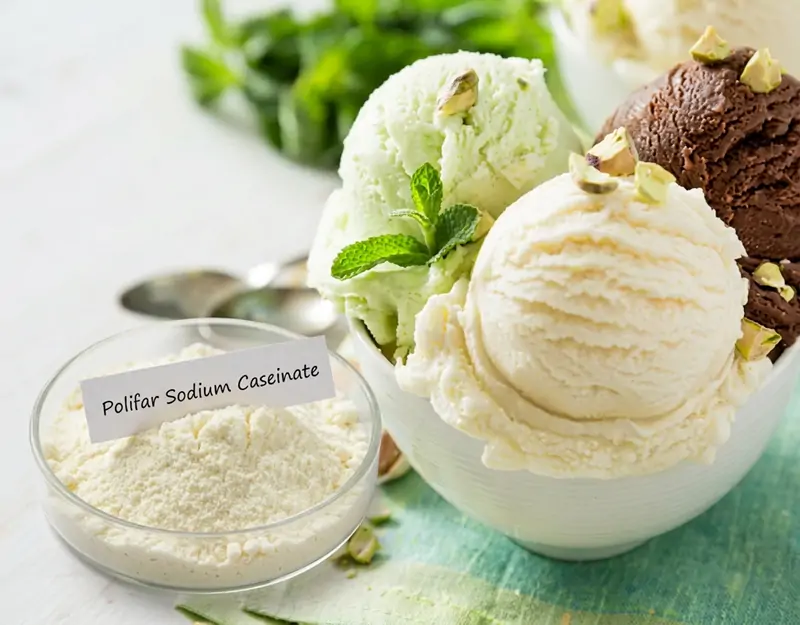
Sodium caseinate has broad ranging uses in the food industry, chiefly in meat products, ice cream and frozen foods, non dairy creamer / coffee whitener, dairy and protein beverages, meal replacement nutrition, fortified infant foods and baked goods.
Sodium caseinate is widely used in processed meat and aquatic foodstuffs. For meat products such as luncheon meat, ham sausages, sausages and bacon, food -grade sodium caseinate locks in moisture, prevents fat breakdown and improves meat cohesion. In aquatic products including fish cakes and fish balls, it preserves springy texture.
Sodium caseinate is common in ice cream and frozen beverages. High moisture cold formulations readily form ice crystals upon freezing, which impair texture. Sodium caseinate stabilises air bubbles inside ice cream, curbs graininess and shrinkage, optimises mouthfeel and stabilises visual appearance.
Sodium caseinate is frequently found in coffee whitener and non dairy creamer. Standard coffee whitener consists of vegetable oil, protein, carbohydrates and other components. Without sodium caseinate these ingredients fail to blend when mixed with water. Sodium caseinate delivers superior emulsification for easy reconstitution and a smooth taste.
Sodium caseinate is applied to dairy drinks, yoghurt and plant based protein beverages. It improves emulsifying performance, reduces fat separation, enhances mouthfeel and overall beverage stability. It also moderately raises viscosity and reinforces protein nutrition.
Sodium caseinate is incorporated into nutritional goods such as protein powders, nutrition bars, meal replacements and sports nutrition products to supply high quality protein, amino acids and sustained release energy. It can also be added to infant foods and foods for special dietary purposes for nutritional fortification (capped at 1.0 g/L for infant formula per GB 2760).
Sodium caseinate brings unique benefits to baked goods. In bread, cakes, biscuits, baking premixes and high protein baked products, it fortifies protein nutrition, modifies dough behaviour, optimises fat dispersion and sensory attributes, yielding visually attractive finished baked items.
Food- grade sodium caseinate has strong water binding capacity. Direct bulk addition to water causes severe clumping, with inner powder failing to hydrate fully. For industrial production, add powder slowly under continuous stirring, apply high shear mixing and allow adequate hydration time to achieve good dispersion.
The isoelectric point of casein is approximately pH 4.6. When the food system pH approaches this value, protein aggregation and precipitation become more likely. Evaluate feasibility before deploying sodium caseinate in acidic beverages.
In high salt meat products, cheese and compound seasonings, sodium chloride, phosphates and calcium ions alter protein to protein interactions. Viscosity, emulsifying performance and foam stability may therefore be compromised. Formulation trials are essential for real world application.
Sodium caseinate shows better heat resistance than some whey proteins; nonetheless it is not fully stable across every combination of temperature, pH and salt concentration. Practical processing must consider pH, temperature, salt concentration, protein concentration and homogenisation parameters in combination.
Since sodium caseinate is extracted from cow’s milk, finished product packaging must carry allergen labelling to indicate that the product is unsuitable for consumers with milk protein allergy.
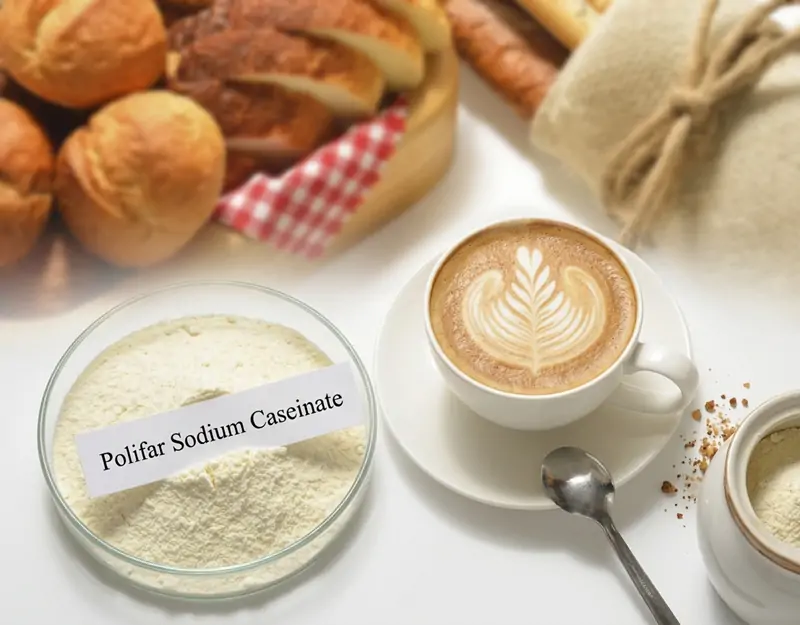
Procurement specialists at food manufacturers routinely request sodium caseinate COA (Certificate of Analysis), sodium caseinate TDS (Technical Data Sheet) and sodium caseinate SDS (Safety Data Sheet) from sodium caseinate manufacturers or suppliers. The COA is especially vital: it contains batch test results referenced against national standards, EU specifications or other globally recognised authoritative criteria.
For food -grade sodium caseinate, protein content is one of the most critical metrics for distinguishing quality grades. Next assess moisture and ash values. Excessive moisture impairs storage stability; ash reflects mineral and salt content. Viscosity and functional performance should also be evaluated. Finally, check batch to batch consistency. Uniform batch test results support stable manufacturing outcomes for food enterprises. Suppliers of sodium caseinate should actively furnish purchasers with COA, TDS, SDS and other key statements and reports.
The primary distinction is that sodium caseinate is not merely a thickener. It functions more as a multi functional food protein raw material: it delivers nutritional protein alongside emulsification, stabilisation, thickening, water retention, foaming and film forming properties. Its stabilisation mechanism differs from hydrocolloid thickeners, which work by raising continuous phase viscosity to slow droplet movement.
The comparison table below clarifies the functional and application differences between sodium caseinate, xanthan gum, CMC, guar gum and carrageenan:
Comparison Item | Sodium Caseinate | Xanthan Gum | Sodium Carboxymethyl Cellulose (CMC) | Guar Gum | Carrageenan |
Main Source | Bovine milk casein | Microbial fermentation | Cellulose derivative | Guar beans | Red seaweed |
Nature | Protein | Polysaccharide | Polysaccharide | Polysaccharide | Polysaccharide |
Core Functions | Emulsification + Thickening + Water retention + Protein fortification | Thickening + Stabilisation | Thickening + Stabilisation + Water retention | Thickening + Water retention | Gelling + Thickening + Stabilisation |
Pure Thickening Efficiency | Medium | High | High | High | Medium |
Emulsifying Capacity | Strong | Auxiliary | Auxiliary | Weak | System dependent |
Water Holding Capacity | Strong | Strong | Strong | Strong | Relatively strong |
Foaming Capacity | Good | Poor | Poor | Poor | Poor |
Protein Nutrition | Present | Absent | Absent | Absent | Absent |
Sensory Characteristics | Creamy, smooth, full bodied | Visco elastic | Viscous, smooth | Full bodied, heavy | Gel like, elastic |
Meat Products | Highly suitable | Usable | Usable | Rarely used as core raw material | Used in specific systems |
Non Dairy Creamer | Highly suitable | Auxiliary | Auxiliary | Rarely used as core emulsifier | Fair |
Ice Cream | Emulsification + Foaming + Texture building | Stabilisation | Stabilisation | Thickening | Gelling / Stabilisation |
Nutritional Beverages | Protein fortification + Emulsification | Stabilisation | Stabilisation | Thickening | System dependent |
Q1: Is sodium caseinate a dairy product?
A1: Yes. Produced by acid treating milk casein followed by neutralisation with sodium salts, sodium caseinate is a milk derived protein raw material.
Q2: Does sodium caseinate contain lactose?
A2: Lactose content is normally very low or nearly absent. Sodium caseinate consists mainly of casein; most lactose is removed during manufacture. Actual lactose content shall be subject to product test reports.
Q3: Is sodium caseinate vegan?
A3: No. Sourced from cow’s milk, sodium caseinate is an animal derived milk protein and does not satisfy vegan food requirements.
Q4: Are sodium caseinate and casein the same substance?
A4: Not exactly identical. Casein is the collective name for a group of milk proteins. Sodium caseinate is the soluble casein salt formed by treating casein with alkaline sodium salts; it features superior dispersibility and emulsifying performance.
Q5: Is sodium caseinate safe for people with lactose intolerance?
A5: Usually tolerable but not universally applicable. Lactose intolerance symptoms stem mainly from lactose digestion issues, and sodium caseinate generally contains minimal lactose. Nevertheless individuals with milk protein allergy must avoid it, because milk protein remains present.
Sodium caseinate is well suited for meat products, ice cream, frozen foods, non dairy creamer, coffee whitener, dairy beverages, plant protein beverages, meal replacement nutrition, fortified infant foods and baked goods. It effectively preserves original product functionality, optimal appearance and desirable mouthfeel. Food manufacturing enterprises should select the most appropriate food ingredient based on product characteristics, processing technology and nutritional targets.
As a premium supplier of food -grade sodium caseinate, Polifar provides global food companies with one stop procurement services for sodium caseinate, alongside professional pre sales consultation and after sales support to empower your food industry business.


