
 English

Views: 0 Author: Site Editor Publish Time: 2026-09-17 Origin: Site


Succinic acid is a natural organic acid, an additive approved by the EU, US FDA, Chinese national standards, and Australian and New Zealand certifications, and required to be used within reasonable limits. In food, it is commonly used to enhance flavor and aroma, regulate acidity, balance pH, preserve freshness, and inhibit bacterial growth. This article will provide a comprehensive introduction to food-grade succinic acid E363 from multiple perspectives.
Succinic acid, also known as bio-based succinic acid, has the molecular formula C₄H₆O₄, a molecular weight of 118.088, and CAS number 110-15-6 . It is a colorless or white crystalline powder, odorless with a characteristic sour taste, and is a naturally occurring, safe, dibasic organic acid. Succinic acid is commonly found in unripe grapes, beets, rhubarb, seaweed, lichens, fungi, and animal and plant tissues.
Succinic acid is classified as a food additive in the European Union, belonging to the category of acidity regulators or flavor enhancers. In the US FDA, it is classified as a flavor enhancer , pH controller , and can also be used as a flavoring agent. In China, succinic acid is commonly used as a food flavoring agent, disodium succinate as a flavor enhancer, and glyceryl monosuccinate as an emulsifier.
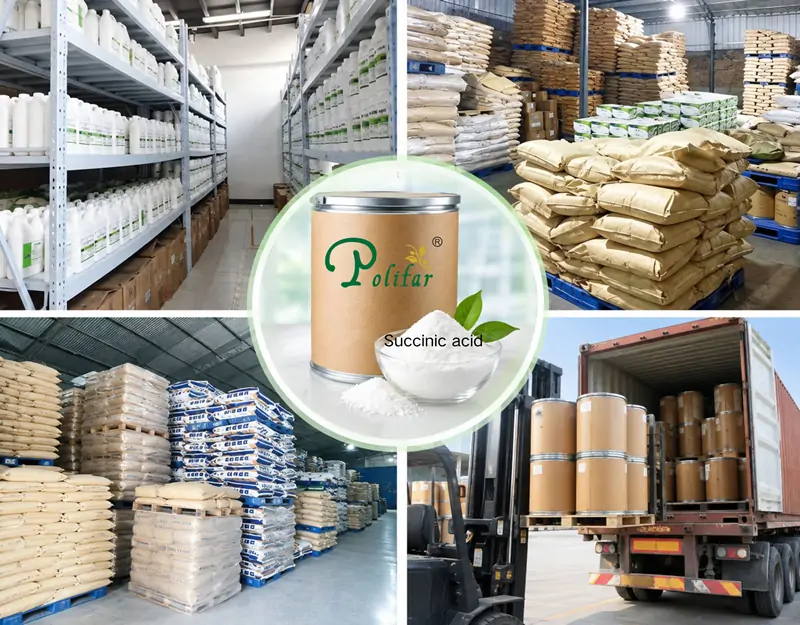
Polifar is a professional food additive supplier dedicated to providing high-quality succinic acid to food companies worldwide. Succinic acid is characterized by its mild acidity, long-lasting and pleasant aftertaste, lack of bitterness, and strong pH buffering capacity . Compared to acidity regulators such as citric acid, lactic acid, malic acid, and fumaric acid, succinic acid is better able to balance the overall flavor of food systems.
Succinic Acid E363 is that it provides acidity while also possessing a unique umami and richness. It not only adjusts acidity but also modulates flavor, complements savory notes, and balances the palate of most people.
Succinic acid is a new generation of bio-based material developed in the 21st century. After years of development and utilization, it now has practical applications in multiple fields. It is mainly used in the food industry, pharmaceutical industry, industrial surfactants, biodegradable plastics industry, and clothing bio-fibers. This article mainly discusses its specific applications in the food industry.
In the food industry, succinic acid is widely used in condiments, alcoholic beverages, soft drinks, confectionery, jellies, baked goods, meat products, soups, and dairy products.
Succinic acid plays an irreplaceable role in condiments. Both disodium succinate and succinic acid are used in condiments. Soy sauce contains amino acids, peptides, salts, organic acids, sugars, and aroma compounds, forming a very complex food flavor system. In the savory and salty food system of soy sauce, acidity should not be too monotonous or prominent; it must participate in the overall flavor construction. Maintaining the overall flavor of condiments such as soy sauce, vinegar, seasoning sauces, meat sauces, compound seasonings, marinades, hot pot bases, and soup bases is not just about sourness, but a complete savory and salty flavor.
Succinic acid also has wide applications in meat products and seafood. It can be combined with food-grade phosphates, such as STPP, to retain the moisture and tenderness of meat products while further optimizing their acidity, flavor, and savory taste. Common meat products such as ham, meatballs, cured meat, and jerky exhibit superior taste after the addition of succinic acid and STPP.
Seafood and aquatic products naturally possess a certain savory and salty flavor, and the natural flavor characteristics of succinic acid are highly compatible with these products. In seafood compound seasonings such as fish balls, shrimp balls, seafood soup, oyster sauce, and fish sauce, it effectively retains moisture and color, gently inhibits bacteria, and effectively extends shelf life.
Succinic acid is also used in beverages and alcoholic drinks, but the mainstream acidity regulators on the market are mainly citric acid, malic acid, and lactic acid. In alcoholic drinks, succinic acid mainly improves the flavor of the drink, suppresses off-flavors, and stabilizes acidity. In beverages, it softens the acidity, adjusts the mouthfeel, and maintains the unique flavor of the beverage.
2.4 Baked and Fermented Foods
Glyceryl succinate can participate in microbial metabolism, and therefore can be widely used in baked bread, protein drinks, dairy products and fermented foods to play a role in emulsification and stabilization.

Succinic acid can adjust the acidity and sweet-sour ratio of candies and jellies, making hard candies, soft candies, and gel candies more flavorful. Citric acid, malic acid, fumaric acid, and other acidity regulators have the same effect, and customers can choose according to their needs.
Succinic acid has a moderate acidity, lower than citric acid and malic acid, but its sour taste is mild, long-lasting, and has a slightly salty (shellfish-like) aftertaste. Therefore, it is suitable for products that require a "sour but not pungent, well-balanced sourness and freshness." In fermented products, it can also mask unpleasant off-flavors. This is why it has been used for a long time in soy sauce, sake, and soup bases.
As a Food Grade Succinic Acid Supplier , Polifar aims to provide a deeper and clearer understanding of acidity regulators by conducting a comparative analysis of different acids with similar characteristics, thus helping consumers make informed choices when selecting acidity regulators.
| Types of Organic Acids | Relative acidity (Citric acid = 100) | Unique Functionality | Flavor Profile and Acidity Characteristics | Key Application Areas |
| Succinic acid (Butanedioic Acid) | Mild; lower potency ranking | Potent synergistic umami enhancer and buffering agent | Mellow acidity with a slight bitterness; features a unique umami note characteristic of shellfish (its disodium salt offers intense umami) | Soy sauce, instant noodle seasonings, seafood processing, brewed alcoholic beverages |
| Citric acid | 100 (Baseline) | Metal ion chelator and antioxidant synergist | Crisp and clean; acidity dissipates rapidly | Carbonated beverages, fruit juice, confectionery, canned fruit |
| Malic acid | 120–125 | Masks the bitter aftertaste of artificial sweeteners; improves mouthfeel | Mellow, lingering acidity with a distinctive fruity aroma | Fruit juice, gummies, fruit wine, low-sugar products |
| Tartaric acid | 120–130 | Inhibits crystal precipitation; acts as a leavening synergist in baking | Intense and sharp; carries the astringency typical of grapes | Baking powder, wine, hard candy, jelly |
| Lactic acid | ~70–80 | Inhibits microbial growth and spoilage; tenderizes meat and retains moisture | Mild, smooth acidity with subtle fermented notes | Lactic acid bacteria beverages, yogurt, kimchi, meat products |
| Acetic acid (ethanoic acid) | ~90 | Potent antimicrobial and natural preservative | Highly pungent with a sharp, volatile acidic odor; dissipates quickly | Vinegar, canned pickles, sauces |
| Fumaric acid | ~150 | TCA cycle intermediate; highly acidic yet has extremely low solubility | Strong acidity but slow to dissolve; astringent mouthfeel; used in candies and beverages (applications limited by low solubility) | Beverages, confectionery, baked goods |
The following conclusions can be drawn from the diagram:
The value of succinic acid lies not in its "acidity" but in its "umami" quality. Its mild acidity and long-lasting, mellow, and lingering salty-umami aftertaste make it widely applicable in soy sauce, sake, and other condiments.
There are two main production processes for succinic acid on the market: the traditional petrochemical process and the bio-based process.
Traditional petrochemical processes require maleic anhydride and fumaric acid as raw materials, which undergo catalytic hydrogenation at approximately 130-140°C, followed by paraffin oxidation to obtain mixed carboxylic acids, from which succinic acid is then separated. The current mainstream trend is to use renewable raw materials such as glucose and straw saccharification liquid, utilizing yeast or fungi for fermentation production. This aligns with the national trend towards low-carbon and green development.
Food-grade succinic acid requires a food additive production license as stipulated by the state. The production process involves several more steps than that of industrial-grade succinic acid, including decolorization, recrystallization, strict control of impurities, and issuance of COA for each batch.
According to Constancy Researchers, the market size of succinic acid was approximately $415 million in 2025, and is projected to continue growing annually over the next 10 years, reaching $1.028 billion by 2035. Market demand is primarily driven by the massive growth in bio-based biodegradable materials, with succinic acid being used as a raw material in the production of PBS/PBAT. There will also be increased demand in the food and beverage, flavoring, pharmaceutical, and cosmetic industries, as well as in industrial applications such as pH adjustment, surfactants, plasticizers, and coatings.
Ingestion within nationally regulated limits generally does not have any adverse effects on health; however, excessive intake can cause gastrointestinal discomfort. International buyers of succinic acid need to be aware of the differences between succinic acid (flavoring), disodium succinate (flavor enhancer), and glyceryl monosuccinate (emulsifier) to avoid delays in import/export processes.
Q1: Does succinic acid cause diarrhea?
A1: At normal food addition levels, succinic acid usually does not cause diarrhea. Excessive intake of acidic substances may irritate the gastrointestinal tract, depending on the amount ingested and individual tolerance.
Succinic acid does not normally cause purging or diarrhea when consumed at typical food-use levels. Excessive intake may cause gastrointestinal discomfort depending on the amount consumed and individual tolerance.
Q2: What are the benefits of succinic acid?
A2: Succinic acid is mainly used as a food acidulant and flavor modifier, providing a mild, refreshing sour taste and helping to improve the overall flavor balance of food.
Succinic acid is mainly used as an acidity regulator and flavor enhancer. It provides a mild, savory-tart taste and helps improve overall flavor balance in foods.
Q3: Where can I buy succinic acid?
A3: Food-grade succinic acid can be purchased from food additive suppliers, chemical raw material distributors, or specialized manufacturers. When purchasing, the product grade, purity, and relevant quality documents should be verified.
Food-grade succinic acid can be purchased from food ingredient suppliers, chemical distributors, or specialized manufacturers. Buyers should verify the product grade, purity, and relevant quality documentation.
Q4: Does succinic acid dissolve in cold water?
A4: Yes, succinic acid is soluble in water, but its solubility and dissolution rate are relatively low in cold water. Heating usually helps improve the dissolution efficiency. In actual food production, the water temperature and stirring method can be adjusted according to the formula and process conditions.
Yes. Succinic acid is soluble in water, but its solubility and dissolution rate are relatively lower in cold water. Heating generally improves dissolution efficiency.
In food processing, water temperature and mixing conditions can be adjusted according to the formulation and production process.
Q5: How Much Maleic Acid and Succinic Acid are in Beer?
A5: Succinic acid is one of the organic acids that may be formed during beer fermentation, and its content is affected by factors such as raw materials, yeast strains, and fermentation processes. Maleic acid is usually not a major natural organic acid in beer, and its content is generally low or may be below the conventional detection range.
Succinic acid is one of the organic acids that may be formed during beer fermentation, and its concentration can vary depending on raw materials, yeast strains, and fermentation conditions.
Maleic acid is generally not considered a major naturally occurring organic acid in beer, and its concentration is typically very low or may be below routine detection limits.
In the future, succinic acid will continue to play its role as a food additive in the market and may extend into the feed additive industry, while maintaining a place in other industrial and pharmaceutical sectors. Polifar will remain at the forefront of development, providing global food users with the highest quality food-grade succinic acid and helping international succinic acid buyers solve their procurement problems in one stop. If you are interested in succinic acid or other food additives or have any questions, please contact Polifar!


