
 English

Views: 0 Author: Site Editor Publish Time: 2026-04-02 Origin: Site


Feed-grade betaine always sees a surge in sales during March and April each year. Betaine is a quaternary ammonium alkaloid naturally found in animals, plants, and microorganisms, named after its initial extraction from sugar beets. Its chemical name is trimethylglycine, with the molecular formula C₅H₁₁NO₂ and a molecular weight of 117.15. Because betaine possesses core values such as methyl donor properties, osmotic pressure regulation, growth promotion, stress resistance, carcass improvement, and appetite stimulant effects, it is widely used in pig, poultry, aquaculture, and ruminant animal farming. Betaine has been a mainstream green multifunctional feed additive globally for over 50 years.
This article focuses on betaine as a feed additive, providing a comprehensive analysis of its physicochemical properties, core application value, application value in different animals, and precautions for use.
Structure: A zwitterionic compound containing quaternary ammonium groups (-N⁺(CH₃)₃) and carboxyl groups (-COOH), with a stable structure.
Appearance: Anhydrous betaine is a white crystalline powder, odorless and sweet-tasting; hydrochloride is a white to slightly yellow crystal with a sour and astringent taste.
Solubility: Extremely soluble in water (solubility 160g/100g water at 20℃), soluble in methanol/ethanol, sparingly soluble in ether and chloroform.
Stability: Melting point 293–305℃, resistant to high-temperature granulation (no deactivation at 120–130℃), pH neutral, resistant to acids and alkalis; however, it is highly hygroscopic and easily deliquescent.
Safety: Natural, non-toxic, residue-free, non-teratogenic and non-carcinogenic, meeting the requirements of green aquaculture.
Storage Conditions: Temperature 2-8℃. Store in a dry and ventilated warehouse.
| Product Types | Active ingredient | Purity | Features | Applicable Scenarios |
| Anhydrous Betaine | Betaine | ≥97% | Pure product, highest methyl efficiency, high cost | High-end formulations, precision nutrition, aquaculture |
| Monohydrate Betaine | Betaine·H₂O | ≥95% | Slightly lower hygroscopicity, high cost-effectiveness | Conventional livestock and poultry, aquaculture |
| Betaine Hydrochloride | Betaine·HCl | 75%–98% | Weak hygroscopicity, easy to store, low cost | Mainstream feeds, premixes |
| Complex Betaine | Betaine + Carrier | 30%–60% | Easy to mix, prevents clumping, low cost | Compound feeds, general aquaculture |
| Microencapsulated/Coated Betaine | Coated pure product | ≥90% | Slow-release, moisture-proof, strong stability | High-temperature pelleting, aquaculture, ruminants |
Betaine is widely found in plants and animals, with the highest content in sugar beets. Betaine can replace some methionine and choline, providing three active methyl groups, participating in the methionine cycle, choline synthesis, and homocysteine metabolism.
Feed-grade betaine is a more efficient methyl source than methionine and choline chloride. Methyl efficiency: 1.8 times that of 50% choline chloride and 2.6 times that of DL-methionine. Therefore, betaine can effectively improve the utilization rate of methionine, saving methionine and reducing formulation costs. It can also promote protein/nucleic acid/phospholipid synthesis, improving nitrogen utilization and growth rate.
Methionine, choline, and betaine each have different physiological functions and cannot completely replace each other, but in terms of methyl donors, they can complement each other. The specific metabolic pathway is as follows: Choline must be oxidized to betaine within the mitochondria to function as a methyl donor.
Betaine can transfer methyl groups to homocysteine to synthesize methionine.
Betaine cannot be reduced back to choline, therefore it cannot replace other physiological functions of choline.
Betaine is an effective cell osmotic protectant that can maintain normal osmotic pressure in animal cells, prevent dehydration caused by water loss from cells, stabilize intestinal ion balance, and thus improve the body's resistance.
Anti-heat stress effect: Under heat stress conditions, betaine can effectively improve cell membrane permeability and reduce the increase in creatine kinase and aspartate aminotransferase during stress. Studies on small-tailed Han sheep have shown that adding 0.5% betaine under heat stress conditions can significantly increase final body weight and average daily weight gain, reduce feed conversion ratio, and significantly reduce respiratory rate and cortisol levels, while increasing growth hormone levels. Increasing betaine intake in feed additives can effectively alleviate heat stress, decreased feed intake, weaning diarrhea, and salinity stress in aquatic animals, improving survival rate and growth stability.
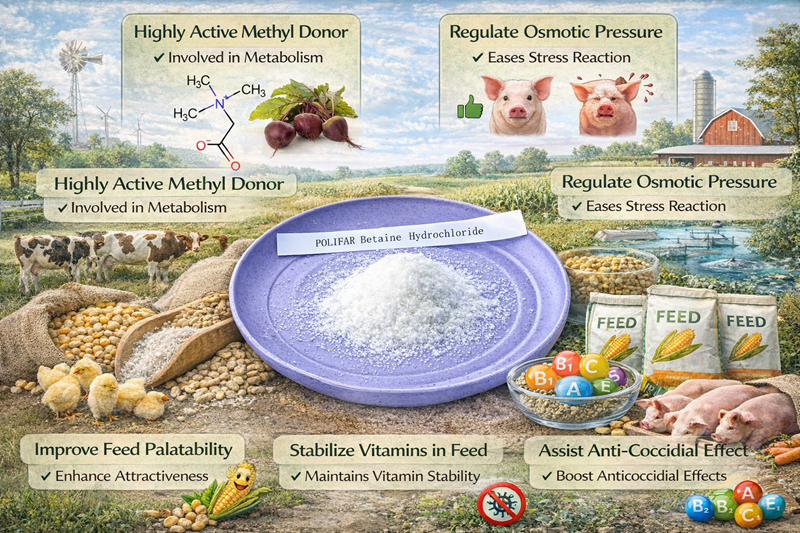
Betaine's effects on fat metabolism are mainly reflected in three aspects:
It provides active methyl groups for phosphatidylcholine synthesis, promoting the synthesis of substances such as RNA and DNA.
It increases carnitine content in the liver and muscles, promoting lipid migration and β-oxidation of fatty acids in the liver.
It significantly reduces malate dehydrogenase activity, accelerating fat decomposition and inhibiting some fat synthesis.
Experiments have shown that adding betaine to pig feed can reduce backfat thickness and increase lean meat percentage and eye muscle area. Adding betaine to poultry feed can significantly reduce abdominal fat percentage and increase pectoral muscle percentage. Adding betaine to aquatic feed can reduce liver fat in aquatic animals and increase meat yield.
Betaine has a natural sweet and umami flavor, which especially stimulates the sense of smell and taste buds of aquatic animals (fish/shrimp), improving palatability. Studies have shown that adding betaine to aquatic feed increases feed intake by 10%-20%, promotes early growth, and effectively reduces the feed conversion ratio.
Adding 0.0001 mol/L of betaine to feed can elicit a taste response in all fish. Betaine can significantly improve the growth performance of hybrid silver carp, increase feed intake, reduce feed loss, and has a significant feeding-promoting effect. Adding betaine to eel feed can increase its preference for compound feed.
Betaine is an amphoteric compound with strong antioxidant properties, which can effectively protect the activity of vitamins in premixes. It prevents the reduction of vitamin potency, especially fat-soluble vitamins, during storage or processing, ensuring their biological efficacy and improving aquaculture efficiency.
Betaine can improve the electrolyte imbalance caused by coccidiosis infection in animals and has a significant inhibitory effect on the reproduction of coccidia schizonts. Studies have shown that in broilers infected with Eimeria tenella, the application of feed containing polyether antibiotics and the addition of betaine can improve broiler weight gain and anticoccidial index. In particular, the maduramycin plus betaine group showed the most significant weight gain (relative weight gain rate increased by 19%) and an anticoccidial index increased by 24.7%.
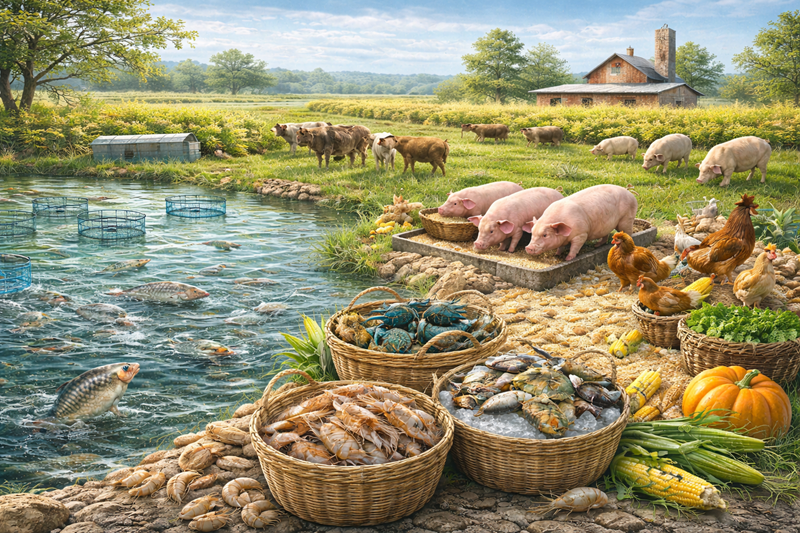
Recommended Intake
Growing pigs: Adding 0.1%–0.2% increases daily weight gain by 5%–10%, reduces feed conversion ratio by 3%–8%; reduces backfat thickness by 8%–15%, and increases lean meat percentage by 2%–4%. Sows/Piglets: Add 0.2%–0.3% during the peripartum period to alleviate heat stress and increase milk production; add 0.15%–0.2% to weaned piglets to reduce diarrhea rate and increase survival rate and daily weight gain.
Cost Value: Replaces 30%–40% of methionine, reducing feed cost by 30–80 yuan per ton.
Effects
Improves production performance and reduces diarrhea rate.
Works by increasing hormone content and stress resistance.
Increases protein deposition and reduces carcass fat content.
Changes nutrient distribution, increasing carcass protein deposition and reducing fat and visceral tissue deposition.
Recommended Intake
Broilers: Add 0.1%–0.15%, increasing daily weight gain by 4%–8%, reducing abdominal fat percentage by 10%–20%, increasing breast muscle percentage by 3%–6%, and reducing feed conversion ratio by 3%–7%. Layer hens: Adding 0.08%–0.12% increases egg production by 2%–5%, improves eggshell strength, reduces breakage rate, reduces liver lipid deposition, and prolongs peak egg production.
Effects
Laying hens: Significantly increases egg albumen height and Haugh units, significantly reduces feed conversion ratio. Increases egg production and reduces malondialdehyde content in the liver.
Broilers: Increases growth rate, reduces feed conversion ratio; improves carcass quality, increases carcass weight and intramuscular fat content; significantly reduces abdominal fat percentage, intramuscular fat width, and subcutaneous fat thickness; reduces intestinal damage caused by coccidiosis infection.
Recommended intake
Pasteurizer: Adding 0.05%–0.1% increases feed intake by 15%–30%, especially effective for cold-water fish, shrimp, and crab.
Effects
Growth: Daily weight gain increased by 8%–15%, feed conversion ratio decreased by 5%–12%; improved resistance to salt/temperature stress and increased survival rate.
Quality: Reduced liver fat, increased meat yield, and firmer meat.
(4) Ruminants (Cattle/Sheep)
Recommended Intake
Beef Cattle/Sheep: Add 0.1%–0.2%, daily weight gain increased by 6%–12%, feed conversion ratio increased by 5%–10%; reduced rumen ammonia loss and improved protein utilization.
Dairy Cows: Add 0.15%–0.25%, increased milk fat percentage and milk production, alleviated heat stress, and improved reproductive performance.
Effects
Final body weight and average daily weight gain increased significantly.
Feed intake-to-weight ratio decreased significantly.
Respiratory rate and rectal temperature decreased significantly.
Serum growth hormone levels increased, and cortisol levels decreased.
The recommended intakes are detailed in the table below.
| Animal Species | Amount added (%, anhydrous / hydrochloride) | Notes: |
| Pigs (Growing/Finishing) | 0.1–0.2 | Sows/Piglets 0.15–0.3 |
| Broiler Chickens/Ducks | 0.1–0.15 | Laying Hens 0.08–0.12 |
| Aquatic Products (Fish/Shrimp) | 0.05–0.1 | Primarily for attracting feed 0.05–0.08 |
| Ruminants (Cattle/Sheep) | 0.1–0.2 | Dairy Cows 0.15–0.25 |
| Premixes/Concentrates | 0.3–0.8 | (Calculated based on complete feed) |
For any questions or misunderstandings, please contact Polifar, an industry expert. A feed additive supplier with decades of experience, Polifar can provide professional advice on your feed additive intake.
(1) Cannot Completely Replace Methionine and Choline
Betaine can only partially replace methionine and choline as a methyl donor, but it cannot completely replace them in protein synthesis or other physiological functions. If the choline content in the diet meets the animal's growth needs, adding betaine will not replace methionine in protein synthesis and will not result in better production performance.
(2) Appropriate Addition
Different animals and different growth stages have different requirements for betaine. It is necessary to add it appropriately according to the animal's growth stage to avoid excessive or insufficient addition leading to unexpected situations during the animal's growth stage.
(3) Match Product Form and Choose Appropriately
Betaine comes in various forms. It is necessary to select the appropriate product based on your own farming scale to better utilize the effects of betaine.
Betaine is a green, efficient, and multifunctional core feed additive. With its four core functions of "methyl donor + osmotic pressure regulation + fat regulation + appetite stimulant," it plays a vital and irreplaceable role in livestock, poultry, aquaculture, and ruminant farming by stabilizing vitamins in feed and assisting in anticoccidial control. Driven by global trends towards large-scale and green farming, its market demand will continue to grow, securing its important position among feed additives. Polifar Group will remain committed to quality, providing global users with the best products and optimal solutions to support your farming business!


